
Short Summary
When Perplexity AI CEO Aravind Srinivas asked OpenAI’s Sam Altman how an individual can pinpoint their true personal strengths, Altman delivered a concise piece of advice: “Whatever comes easy to you, but seems hard to other people.” This mental model encourages professionals to bypass traditional “passion-seeking” and focus on asymmetric effort-to-output ratios. For Srinivas, this validated an approach he had applied years earlier during a hackathon at IIT Madras. By leveraging natural problem-solving speed over formal academic credentials, Srinivas progressed from research roles at leading AI labs to founding Perplexity AI.
Introduction
Career advice in the technology sector frequently leans on vague expressions like “follow your passion” or “work harder than everyone else.” However, in fast-moving industries like artificial intelligence, these axioms often fail to provide clear strategic direction.
During a discussion on identifying individual strengths, Perplexity AI co-founder and CEO Aravind Srinivas asked OpenAI CEO Sam Altman a core question: How do you actually determine what you are naturally good at? Altman’s response offered a disarmingly straightforward heuristic that redefines how professionals evaluate talent, execution speed, and long-term career positioning.
What Happened?
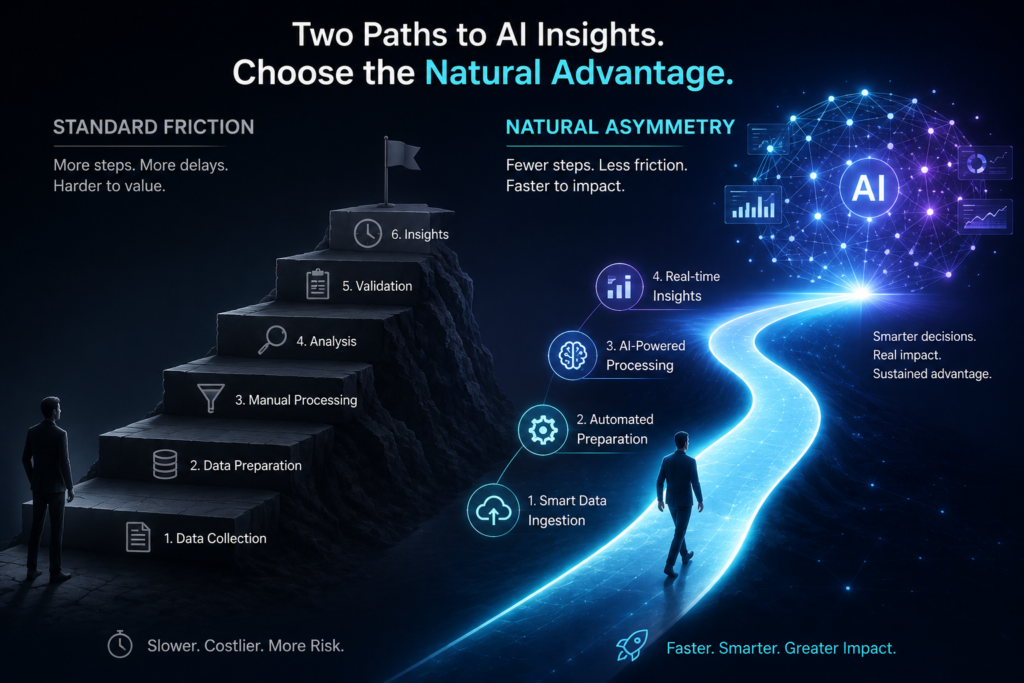
Speaking on podcasts and reflecting on conversations shared across social media platforms, Aravind Srinivas recalled the moment he sought career guidance from Sam Altman. Rather than advising him on technical stack selection or specific startup opportunities, Altman offered a baseline metric for identifying personal advantages: pursue the tasks that feel effortless to you but present significant difficulty to others.
+-------------------------------------------------------------------+
|                     TRADITIONAL CAREER ADVICE                     |
| Focus on Passion -> High Effort & Friction -> Uncertain Value     |
+-------------------------------------------------------------------+

                                  vs.

+-------------------------------------------------------------------+
|                    ALTMAN'S ASYMMETRIC HEURISTIC                  |
| Identify Low Effort (You) vs. High Difficulty (Others) -> Scale   |
+-------------------------------------------------------------------+
For Srinivas, the statement served as a formal articulation of an experience he had years earlier as an undergraduate student at IIT Madras. Long before co-founding Perplexity AI, Srinivas entered an early data science contest without formal machine learning training. While other participants approached the problem theoretically, Srinivas applied the Python scikit-learn library to iteratively test model configurations against hidden test sets until he achieved a winning score. The realization that rapid model experimentation felt natural to him—while frustrating others—became the foundation of his career trajectory.
Why It Matters
Altman’s perspective challenges conventional talent frameworks across technology and corporate environments. Traditional career development emphasizes overcoming personal weaknesses through practice, often viewing high effort as an inherent virtue.
In contrast, Altman’s framework treats high friction as a signal of inefficiency. When an individual finds a domain where their relative effort yields higher output than average, that gap represents a sustainable competitive advantage.
                                high
                                  ^
                                  |   [ WASTED EFFORT ]          [ UNFAIR ADVANTAGE ]
                                  |   High effort required for   Low effort for you,
                                  |   standard results.          hard for others.
         DIFFICULTY FOR OTHERS    |
                                  |   [ LOW VALUE ]              [ CONVENTIONAL SKILL ]
                                  |   Easy for everyone.         Hard for everyone,
                                  |                              requires high grit.
                                  +------------------------------------------------->
                                  low                 EFFORT FOR YOU               high
In the AI sector, where algorithms, frameworks, and deployment strategies evolve constantly, relying on formal course completion can cause developers to lag behind. Recognizing where your execution outpaces the room allows founders and engineers to focus on high-leverage problems.
Technical Explanation
Srinivas’s early contest win highlights a core principle in modern machine learning execution: empirical iteration versus theoretical derivation.
When Srinivas participated in his first Kaggle-style data competition, machine learning workflows relied heavily on tabular data processing and optical character recognition (OCR) techniques. Rather than spending weeks studying mathematical theory behind algorithm decision boundaries, Srinivas leveraged pre-built software abstraction layers:
- Abstraction Libraries (
scikit-learn): Standardized tools that package complex algorithms—such as Random Forests, Decision Trees, and Gradient Boosting—into accessible code methods (fit,predict). - Cross-Validation & Grid Search: Mechanically testing various hyperparameter combinations against a hidden validation dataset to maximize predictive performance without overfitting.
- Rapid Feedback Loops: Prioritizing immediate empirical results from code execution over protracted manual calculations.
+-------------------------------------------------------------------+
|                    EMPIRICAL ITERATION PIPELINE                   |
| Dataset -> Scikit-Learn Pipeline -> Test Predictions -> Adjust    |
+-------------------------------------------------------------------+
                                  |
                                  v
+-------------------------------------------------------------------+
|                        THEORETICAL APPROACH                       |
| Manual Theory Math -> Proof Validation -> Delayed Code Setup      |
+-------------------------------------------------------------------+
By prioritizing fast iteration over manual derivation, Srinivas proved that empirical experimentation often yields faster practical breakthroughs in applied software engineering.
Key Highlights
- The Asymmetric Advice: Sam Altman advised identifying work that feels straightforward to you while remaining challenging to others.
- Practical Validation: Srinivas tested this principle by winning an early data science contest at IIT Madras without formal ML training.
- Prioritizing Output: The heuristic favors empirical execution and rapid feedback over formal credentials.
- Academic & Industry Experience: Srinivas built on this approach during his PhD at UC Berkeley and research roles at DeepMind, Google Brain, and OpenAI.
- Enterprise Scaling: Perplexity AI has expanded its platform into conversational search and enterprise synthesis tools.
Benefits
For Developers and Engineers
- Faster Career Alignment: Directing effort toward intuitive strengths helps developers avoid long periods of low-margin skill development.
- Focus on Practical Proofs: Projects, open-source contributions, and practical prototypes demonstrate capability faster than theoretical degrees.
For Startups and Organizations
- Optimal Role Alignment: Placing engineers in roles aligned with their natural execution styles improves overall team output.
- Higher Execution Velocity: Teams built around natural problem-solvers iterate rapidly, reducing the time required to bring products to market.
Challenges
While Altman’s advice offers a useful heuristic, relying on it blindly presents potential downsides:
- Risk of Avoiding Necessary Skill Gaps: Essential engineering tasks—such as writing test suites, maintaining documentation, and ensuring system security—can feel tedious. Avoiding them simply because they lack instant gratification can create technical debt.
- Confusing Unfair Advantages with Early Skill Gaps: Beginners may mistake initial learning hurdles for a lack of natural talent, causing them to abandon valuable fields prematurely.
- Over-Indexing on Brute-Force Iteration: In complex system design, brute-force experimentation must eventually be balanced with rigorous architectural planning to ensure long-term stability.
Future Outlook
As AI tools lower the barrier to entry for coding and data analysis, the value of memorizing syntax or theoretical algorithms continues to decline. The competitive advantage in technology is shifting toward rapid synthesis, system orchestration, and contextual intuition.
In this environment, heuristics like Altman’s become increasingly relevant. Engineers who identify where their intuition outperforms standard approaches will lead the development of next-generation software architectures, autonomous agents, and enterprise AI platforms.
Our Analysis
Altman’s advice to Srinivas captures a key operational reality of the modern tech ecosystem: asymmetry is the ultimate competitive moat.
Srinivas’s journey—from an undergraduate student using open-source libraries to the CEO of a major AI search engine—demonstrates that self-awareness is an underrated technical asset. By measuring where his output naturally exceeded his input friction, he bypassed standard career tracks and built an enterprise platform that continues to challenge traditional information retrieval models.
FAQ
1. What was the exact advice Sam Altman gave Aravind Srinivas?
Sam Altman advised Srinivas to focus on tasks and domains that come easily to him but seem difficult to other people.
2. How did Srinivas test this advice during his early career?
Srinivas tested the principle by entering an IIT Madras data science contest without formal ML training. By rapidly experimenting with code libraries, he won the competition against more experienced peers.
3. Why is this heuristic different from traditional career advice?
Traditional advice often emphasizes following one’s passion or spending time improving personal weaknesses. Altman’s framework focuses on relative effort gaps, guiding individuals toward their natural comparative advantages.
4. What is Perplexity AI?
Co-founded by Aravind Srinivas in 2022, Perplexity AI is an answer engine that leverages large language models to deliver direct, cited answers to complex search queries.
5. What academic and professional background does Aravind Srinivas have?
Srinivas holds an engineering degree from IIT Madras and a PhD in Computer Science from UC Berkeley, alongside research experience at DeepMind, Google Brain, and OpenAI.
Conclusion
Sam Altman’s advice to Aravind Srinivas provides a practical framework for navigating a tech career. By shifting focus away from subjective passion and toward relative ease of execution, professionals can identify their genuine competitive advantages. As AI continues to transform the software industry, recognizing and leveraging these natural strengths remains one of the most reliable paths to driving meaningful innovation.