
Short Summary
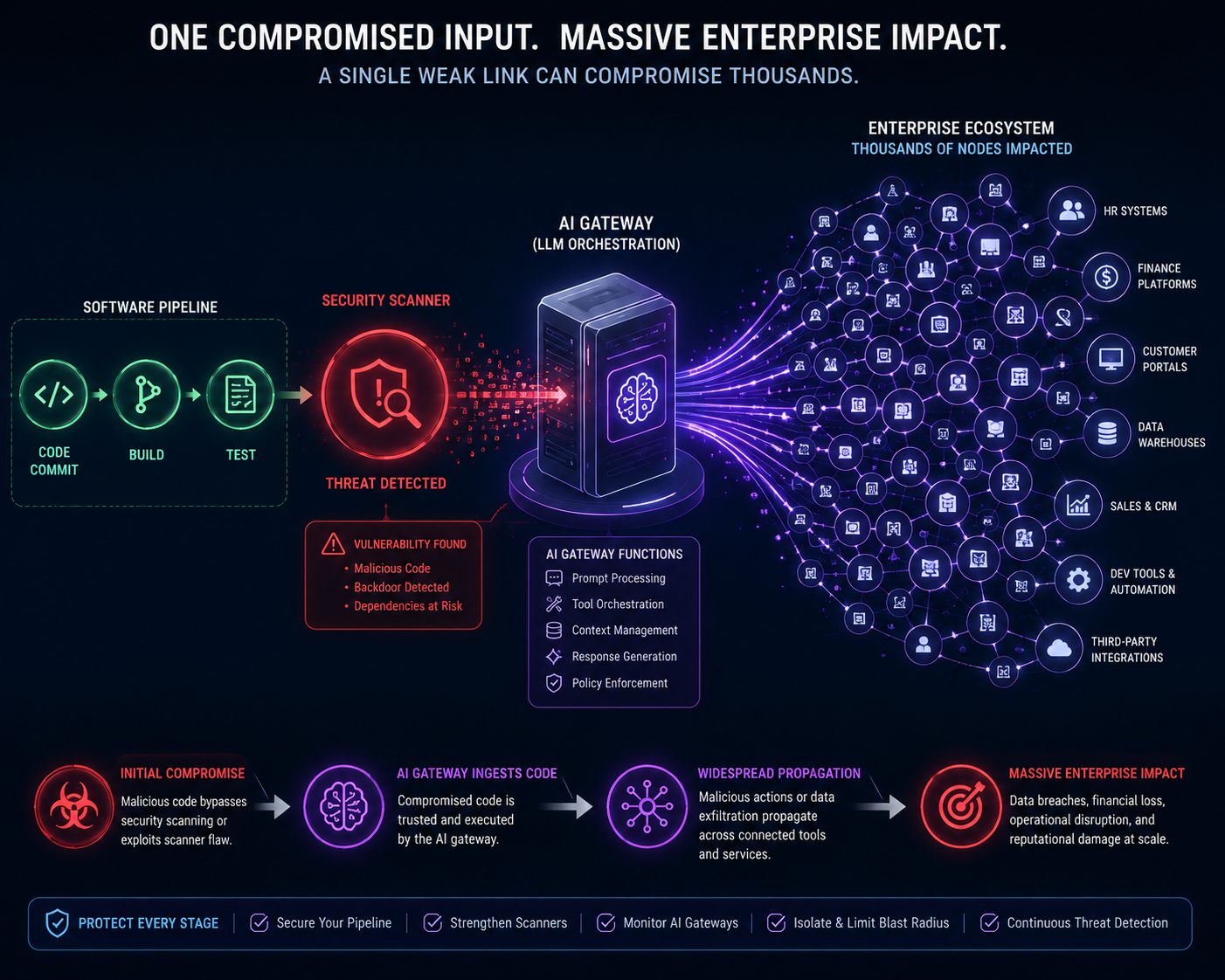
Fresh intelligence published in mid-August 2026 highlights the massive scale of a software supply-chain breach that began earlier in the year. By poisoning Trivy, a ubiquitous security scanner, attackers hijacked automated pipelines to publish malicious versions of LiteLLM—an open-source artificial intelligence (AI) gateway. The resulting credential-stealing campaign compromised over 434,000 build pipelines and exposed critical secrets across more than 2,500 companies, including major technology firms and government entities.
Introduction
In modern software development, automation is built on implicit trust. Continuous Integration and Continuous Deployment (CI/CD) pipelines automatically fetch external software libraries, execute vulnerability checks, and push updates without direct human oversight.
When attackers compromise a foundational utility within this automated chain, they do not need to breach thousands of corporate networks individually. Instead, they let trusted software perform the entry on their behalf.
This dynamic lies at the heart of the cascading breach involving Trivy (a security scanner) and LiteLLM (an AI proxy gateway). Recent findings from threat-intelligence analysts at CloudSEK confirm that what originally appeared to be a brief, localized package infection was actually one of the most expansive software supply-chain compromises recorded.
The incident illustrates a troubling shift in cyberattacks: adversaries are actively targeting the specialized AI toolchains that manage enterprise credentials.
What Happened?
The attack did not start with the AI gateway itself. It unfolded as a sequential, multi-stage operation starting in March 2026:
+------------------+     +------------------+     +------------------+     +-------------------+
|  1. COMPROMISE   | --> | 2. FORGE RELEASE | --> | 3. POISON PIPES  | --> |  4. EXFILTRATE    |
|  Trivy Scanner   |     |  Trojanized      |     | Automated builds |     | Cloud keys, SSH,  |
|  (CVE-2026-33634)|     |  LiteLLM Packages|     | pull PyPI releases|    | API credentials   |
+------------------+     +------------------+     +------------------+     +-------------------+
- Initial Vector (March 19, 2026): Attackers leveraged compromised access credentials to tamper with Trivy, a standard vulnerability scanner maintained by Aqua Security. Cataloged as CVE-2026-33634, the exploit allowed adversaries to push malicious Docker images and compromise release tags used in GitHub Actions.
- Cascading to PyPI: Using credentials harvested directly from those compromised build environments, the threat actors gained access to publish artifacts for LiteLLM, a popular open-source Python library used to route traffic across various Large Language Model (LLM) providers.
- Distribution Window: Two trojanized versions of LiteLLM (v1.82.7 and v1.82.8) were uploaded to the Python Package Index (PyPI) carrying silent credential-harvesting code.
- Execution: Although the compromised packages remained active on PyPI for only about 40 minutes before removal, automated build pipelines globally pulled the update instantly.
The short duration was more than enough. The embedded malware executed immediately upon installation, harvesting live environment variables, cloud access tokens, and API credentials from the host systems.
Why It Matters
This incident reveals how structural weaknesses in automated development environments allow localized attacks to multiply rapidly.
- Massive Blast Radius: CloudSEK’s analysis indicates that over 2,500 organizations and 434,000 individual pipelines were exposed. The stole data archive contained roughly 434,000 files exfiltrated from build servers worldwide.
- High-Profile Collateral Damage: Stolen credentials enabled unauthorized access to internal assets across prominent organizations. Security vendor Checkmarx reported compromised GitHub repositories, Cisco suffered source code exposure linked to the Trivy vector, and CERT-EU confirmed that a European Commission AWS cloud tenant was breached, resulting in the exfiltration of nearly 91.7 gigabytes of compressed data.
- Failure of Traditional Patching: Software updates fix code flaws, but they do not revoke leaked credentials. Simply removing the malicious package leaves systems vulnerable if the stolen keys remain active in cloud environments.
Technical Explanation
To understand why this breach spread so fast, it helps to examine the architecture of automated software pipelines and the mechanics of the payload.
                  +----------------------------------------------+
                  |         CI/CD PIPELINE EXECUTION             |
                  +----------------------------------------------+
                                         |
                       +-----------------+-----------------+
                       |                                   |
                       v                                   v
             [Build Environment]                  [Production Systems]
                       |                                   |
        +--------------+--------------+                    |
        |                             |                    |
        v                             v                    v
+---------------+             +---------------+   +------------------+
| Environment   |             | Process       |   | Cloud Provider   |
| Variables     |             | Memory        |   | Accounts         |
| (AWS Keys,    |             | (Runner.Worker|   | (Storage,        |
|  K8s Tokens)  |             |  unmasked)    |   |  Deployment)     |
+---------------+             +---------------+   +------------------+
        |                             |                    |
        +--------------+--------------+                    |
                       |                                   |
                       v                                   v
          [Encrypted Exfiltration] -------------> [Attacker Infrastructure]
1. Unattended Dependency Resolution
Modern application frameworks use package managers (such as Python’s pip or Node’s npm) to fetch software components automatically. When build scripts specify version ranges without explicit checksum locks, the build system downloads whatever package version is newest at that exact second.
2. High-Value Memory Scrape
In automated CI/CD runners (like GitHub Actions), sensitive keys are injected as environment variables so the runner can authenticate to cloud providers (e.g., AWS, GCP, Azure) or code repositories.
The malicious LiteLLM code contained a specialized script that scanned internal system memory (specifically reading /proc/*/environ and runner process memory). This allowed the malware to bypass traditional log-masking controls and grab plaintext credentials for:
- Cloud access keys (AWS IAM, GCP Service Accounts, Azure Principal tokens)
- SSH keys and Kubernetes cluster certificates
- OpenAI, Anthropic, and database authentication strings stored alongside the AI gateway
3. Persistent Execution
Rather than relying only on a one-time execution during build, the infected LiteLLM packages dropped a initialization file (litellm_init.pth) into the Python environment. This ensured that the malicious script executed every single time any Python process started on that host, maintaining local persistence even after main files were replaced.
Key Highlights
- Threat Actor Attribution: Security researchers track the campaign’s operators under the designation TeamPCP (also tracked by Google as UNC6780).
- The AI Gateway Vector: Attackers explicitly targeted an AI integration tool (LiteLLM) because AI proxies routinely consolidate multiple high-value, production-level API keys.
- 40-Minute Impact Window: The malicious packages were available on PyPI for less than an hour, proving that automated pipelines can be compromised almost instantly.
- CISA Warning: The primary vulnerability behind the initial scanner compromise (CVE-2026-33634) was added to CISA’s Known Exploited Vulnerabilities catalog with strict mitigation deadlines.
Benefits
Understanding the lessons from the LiteLLM and Trivy incidents offers major structural advantages for security teams:
- Clear Secret Boundaries: Highlights the critical need to segregate build-time scanner privileges from production deployment credentials.
- Shift to Hardened Provenance: Encounters like this accelerate the adoption of cryptographic artifact signing, ensuring pipelines only run verified code.
- Proactive Secret Revocation: Prompts security teams to implement automated credential rotation policies rather than relying solely on vulnerability scanning.
Challenges
Defending modern development environments against automated supply-chain incursions involves several major obstacles:
- Transitive Dependencies: Developers may not install LiteLLM directly; third-party sub-packages can pull affected software into build environments without explicit developer knowledge.
- Clean-Up Complexity: Removing a malicious package from a repository does not remove persistent artifacts (like Python
.pthfiles) or deactivate exfiltrated API keys. - Speed of Automation: Security teams cannot review dependencies manually when continuous integration pipelines build and test software hundreds of times per day.
Job Description
As generative AI development matures, AI gateways, model orchestration libraries, and vector database connectors will increasingly become prime targets for cyber criminals. Because these tools centralize connections to external cloud providers and proprietary enterprise data, securing the AI supply chain will require stricter isolation standards.
We expect enterprise security strategies to pivot rapidly toward zero-trust build environments, where pipelines run with ephemeral, short-lived tokens valid for minutes rather than permanent access keys.
Our Analysis
This incident underscores a fundamental paradox in modern cybersecurity: tools designed to inspect and secure code can themselves become primary attack vectors.
The issue was not simply that LiteLLM contained malicious code for 40 minutes. The core failure was that automated build pipelines were granted broad, persistent credentials while executing unverified third-party scripts.
Moving forward, organizations must treat security scanners and third-party utility packages with the same zero-trust discipline applied to untrusted external code.
FAQ
What was the cause of the LiteLLM compromise?
The breach originated from an earlier attack on the Trivy security scanner (CVE-2026-33634). Attackers stole credentials from build environments running Trivy and used them to publish malicious updates for LiteLLM on PyPI.
Why are AI gateways like LiteLLM high-value targets?
AI gateways manage and route connections across multiple LLM providers. As a result, they store or process concentrated collections of active API keys, database credentials, and cloud tokens, making them attractive targets for credential theft.
Is updating to a clean version of LiteLLM enough to fix the breach?
No. Updating patches the package, but any secrets exposed during the execution window must be fully rotated immediately. Additionally, security teams must check for persistent artifacts (such as local .pth files) left behind by the payload.
How long were the infected LiteLLM packages available?
The malicious packages (versions 1.82.7 and 1.82.8) were active on PyPI for approximately 40 minutes before being identified and taken down.
How can organizations prevent similar supply-chain attacks?
Organizations should pin dependencies to cryptographic hashes rather than version tags, restrict network access during build steps, run security tools with minimal privileges, and use short-lived, ephemeral build tokens.
Conclusion
The Trivy-LiteLLM supply-chain cascade is a stark reminder of the risks embedded in modern software automation. When trusted security and AI utilities are turned into delivery mechanisms for malware, speed and convenience can quickly lead to widespread compromise. Preventing future breaches requires organizations to adopt strict dependency pinning, isolate build environments, and assume that any credential exposed to an automated pipeline must be routinely rotated.