
Short Summary
A high-stakes federal trial against Meta Platforms kicked off in Oakland, California, with state attorneys general alleging the tech giant knowingly addicted young users to Facebook and Instagram. Legal experts are drawing direct comparisons to the historic 1990s Big Tobacco settlements. Despite the potential for astronomical financial penalties and mandated product overhauls, Wall Street investors are taking the legal reckoning in stride.
Introduction
As Hollywood prepares to release The Social Reckoning—a cinematic sequel dramatizing early-2020s whistleblower leaks—a far more consequential legal drama is unfolding in the real world. On August 18, 2026, oral arguments officially commenced in a federal courtroom in Oakland, California, launching what could become the most defining courtroom battle in social media history.
Meta Platforms, the parent company of Facebook and Instagram, is defending itself against a multi-state lawsuit alleging that it systematically hooked children and teenagers on its platforms while ignoring internal safety research. Legal scholars are comparing the proceedings to the landmark 1990s litigation against major tobacco companies. Yet, while the public health implications and potential damages are staggering, the financial markets have reacted with remarkable calm.
What Happened?
A coalition of state attorneys general—led in court by California, Colorado, Kentucky, and New Jersey—has brought Meta to trial before U.S. District Judge Yvonne Gonzalez Rogers. The lawsuit alleges that Meta deliberately engineered its social networks to maximize youth engagement at the expense of mental health.
Opening statements delivered on August 18 painted a stark picture of corporate priorities. State prosecutors argued that Meta deployed psychologically manipulative features to trap young minds, downplayed internal research showing negative mental health impacts, and illegally collected data from children under the age of 13 in violation of the Children’s Online Privacy Protection Act (COPPA).
Meta’s defense team counters that the states are misrepresenting company policies and misconstruing standard industry features, insisting that the company actively works to protect teens and remove underage accounts.
Why It Matters
This case represents a pivotal moment for the tech industry’s business model. For decades, consumer-facing internet platforms have operated under business models that monetized user attention through targeted advertising. If states successfully prove that engagement-maximizing features constitute a public nuisance or defective product design, the entire social media ecosystem could be forced to pivot.
The comparison to the 1990s Big Tobacco litigation highlights the potential scale of this shift. Decades ago, state attorneys general successfully sued cigarette manufacturers not for selling tobacco, but for hiding internal research about its addictive nature and targeting minors. That effort resulted in the 1998 Master Settlement Agreement, which forced sweeping changes to tobacco marketing and triggered hundreds of billions of dollars in payouts. A similar outcome against Meta could fundamentally rewrite how social platforms operate.
Technical Explanation
To navigate user protection laws like Section 230 of the Communications Decency Act—which generally shields internet platforms from liability over user-posted content—plaintiffs are focusing on software architecture rather than third-party speech. The lawsuit targets the underlying mechanics of modern social media engines:
+-------------------------------------------------------------------+
|                   Engagement Engine Architecture                  |
+-------------------------------------------------------------------+
        |                                           |
        v                                           v
+-------------------------------+   +-------------------------------+
|    Algorithmic Feedback       |   |    Intermittent Rewards       |
|  - Infinite Scrolling Feeds   |   |  - Push Notifications         |
|  - Data-Driven Recommendations|   |  - Public "Like" Indicators   |
+-------------------------------+   +-------------------------------+
        |                                           |
        +---------------------+---------------------+
                              |
                              v
              Psychological Habit Formation
              (High Retention / Maximized Ad Exposure)
Algorithmic Feeds & Dark Patterns
Rather than chronological updates, modern feeds rely on recommendation algorithms that evaluate thousands of signals to predict what content will keep a user scrolling. Plaintiffs classify infinite scrolling and auto-playing videos as “dark patterns”—interface designs crafted to bypass conscious decision-making and encourage habitual consumption.
Variable Reward Schedules
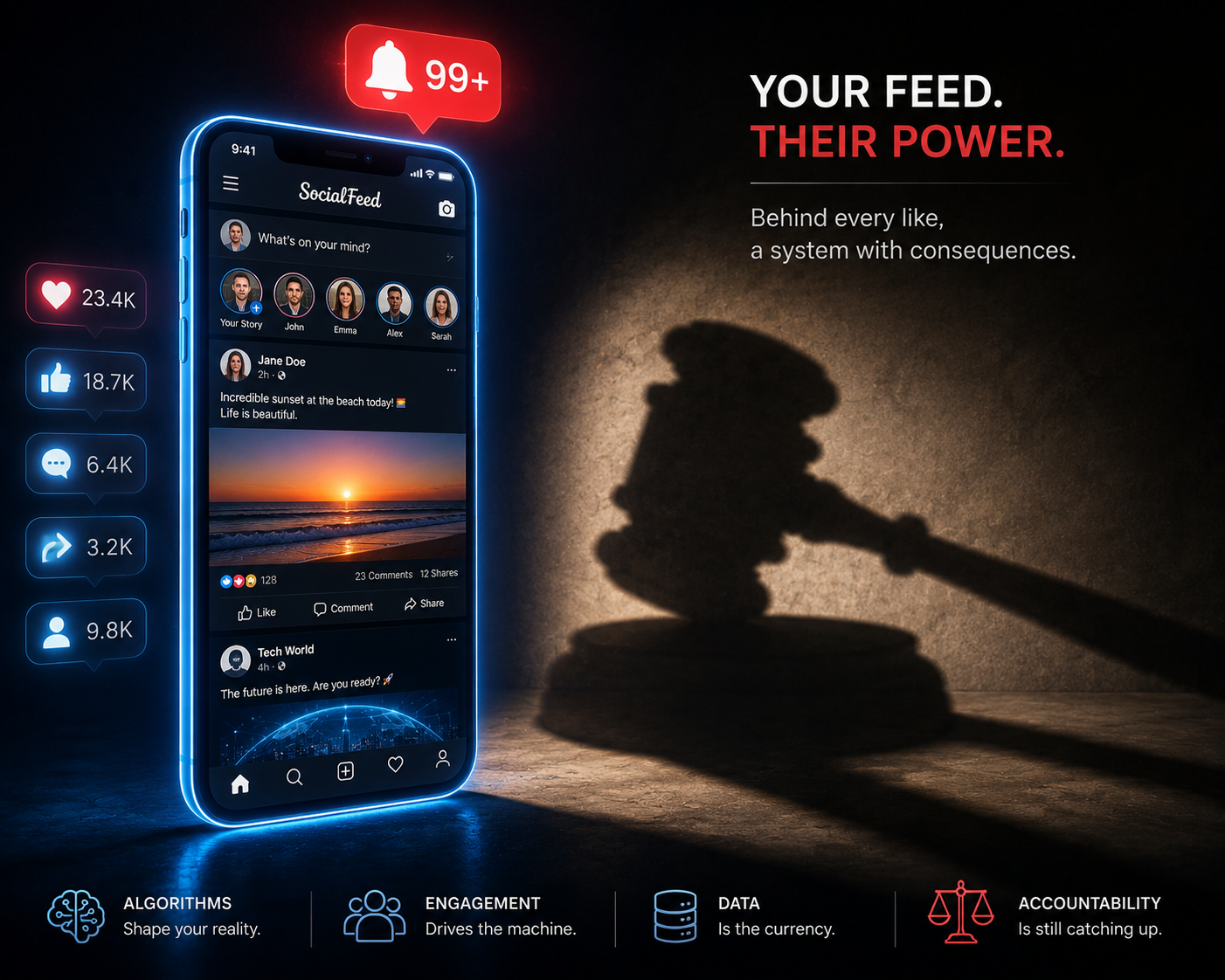
Features such as visual “likes,” comment notifications, and view counts function similarly to slot machines. By delivering unpredictable social validation at irregular intervals, the platform triggers dopamine releases in developing brains, building continuous feedback loops that make it difficult for young users to log off.
Key Highlights
- Oakland Federal Trial Begins: Oral arguments opened on August 18, 2026, launching a six-week federal trial in Oakland, California.
- Star Witnesses Slated to Testify: Meta CEO Mark Zuckerberg, Instagram chief Adam Mosseri, and prominent whistleblowers are expected to take the stand.
- Focus on App Design, Not Content: The legal strategy bypasses traditional free speech defenses by targeting structural features like infinite scrolling, push notifications, and “like” counts.
- Big Tobacco Strategy: Prosecutors are leveraging consumer protection statutes and COPPA data collection rules to hold Meta accountable for public health impacts.
- Advisory Jury, Judicial Verdict: While an eight-person advisory jury evaluates evidence, District Judge Yvonne Gonzalez Rogers will issue the final verdict and determine remedies.
Benefits
Proponents of the lawsuit argue that a victory for the state attorneys general could yield major societal benefits:
- Safer Platform Architecture: Mandated product overhauls could eliminate infinite scrolling, disable default push notifications for minors, and turn off public engagement counts.
- Enhanced Parental Controls: Platforms would be forced to implement robust age verification and grant parents greater oversight over secondary accounts.
- Greater Corporate Transparency: Legal discovery processes pull internal safety research into the public domain, preventing companies from hiding risks.
Challenges
Despite the momentum behind youth safety advocates, the prosecution faces distinct hurdles:
+-------------------------------------------------------------------+
|                     Key Prosecution Hurdles                       |
+-------------------------------------------------------------------+
|  1. Causation vs. Correlation                                     |
|     Proving platform mechanics directly cause harm vs. general    |
|     mental health factors.                                        |
+-------------------------------------------------------------------+
|  2. Legal Precedent & Section 230 Boundaries                      |
|     Navigating statutory immunities that protect online platforms.|
+-------------------------------------------------------------------+
|  3. Industry-Wide Nuances                                         |
|     Disentangling Meta's specific apps from overall screen time  |
|     and competitor platforms.                                     |
+-------------------------------------------------------------------+
Establishing direct causation remains complex. Meta’s defense highlights that mental health trends among youth are influenced by diverse societal factors, making it difficult to attribute specific harms solely to Instagram or Facebook. Furthermore, defining where product optimization ends and illegal “addiction” begins presents a high legal bar.
Future Outlook
The trial in Oakland is scheduled to run through late September, with a final ruling expected in early October 2026. The fallout from this verdict could take several paths:
- Mandated Product Changes: If Judge Gonzalez Rogers rules against Meta, the company could be ordered to disable algorithmic recommendations for users under 18 and rebuild default safety settings.
- Financial Penalties: State prosecutors have cited damages that could reach tens to hundreds of billions of dollars. Even if reduced on appeal, the financial precedent could alter corporate risk calculations across the tech sector.
- Cross-Industry Ripple Effects: Similar lawsuits pending against TikTok, YouTube, and Snap could gain massive momentum, accelerating a industry-wide redesign of social media interfaces.
Our Analysis
Why are investors taking a trial with potential multi-billion-dollar liabilities so lightly? Meta’s robust balance sheet, record revenues, and massive cash reserves give Wall Street confidence that the tech giant can absorb substantial fines without disrupting core operations. Moreover, markets recognize that any adverse ruling will spark years of appeals.
However, Wall Street may be underestimating the structural risks. While Meta can easily write a check for financial penalties, mandatory changes to app design pose a direct threat to user retention and ad inventory. If Instagram is forced to remove algorithmic recommendations or limit push notifications for younger audiences, time spent on the app will inevitably decline. In the long run, product re-engineering—not financial payouts—represents the true risk to Meta’s valuation.
FAQ
What is the Meta blockbuster trial in Oakland about?
A coalition of state attorneys general alleges that Meta deliberately designed Facebook and Instagram with addictive features that harm the mental health of children and teenagers, while hiding internal safety research from the public.
Why is this case compared to Big Tobacco?
Like the historic 1990s litigation against cigarette manufacturers, this trial targets corporate practices, alleging that Meta knew its products carried public health risks for young people but continued to market them to maximize profits.
Who is expected to testify in the trial?
High-profile tech executives—including Meta CEO Mark Zuckerberg and Instagram head Adam Mosseri—are expected to give testimony, alongside whistleblowers and academic researchers.
Could Meta be forced to change how Instagram and Facebook work?
Yes. In addition to financial penalties, state prosecutors are asking the court to order structural changes to Meta’s apps, such as disabling addictive design features and altering data collection practices for minors.
How have investors and Wall Street reacted to the trial?
Investors have remained calm, buoyed by Meta’s high profitability, market capitalization, and the expectation that any court ruling will face years of legal appeals.
Conclusion
The federal trial underway in Oakland marks a critical juncture for Big Tech. As state prosecutors attempt to draw a line between engaging user design and illegal platform addiction, the court’s decision will resonate far beyond Silicon Valley. Whether the outcome results in monumental financial settlements or court-ordered app redesigns, the social media landscape is facing an unprecedented wave of accountability.