
Short Summary
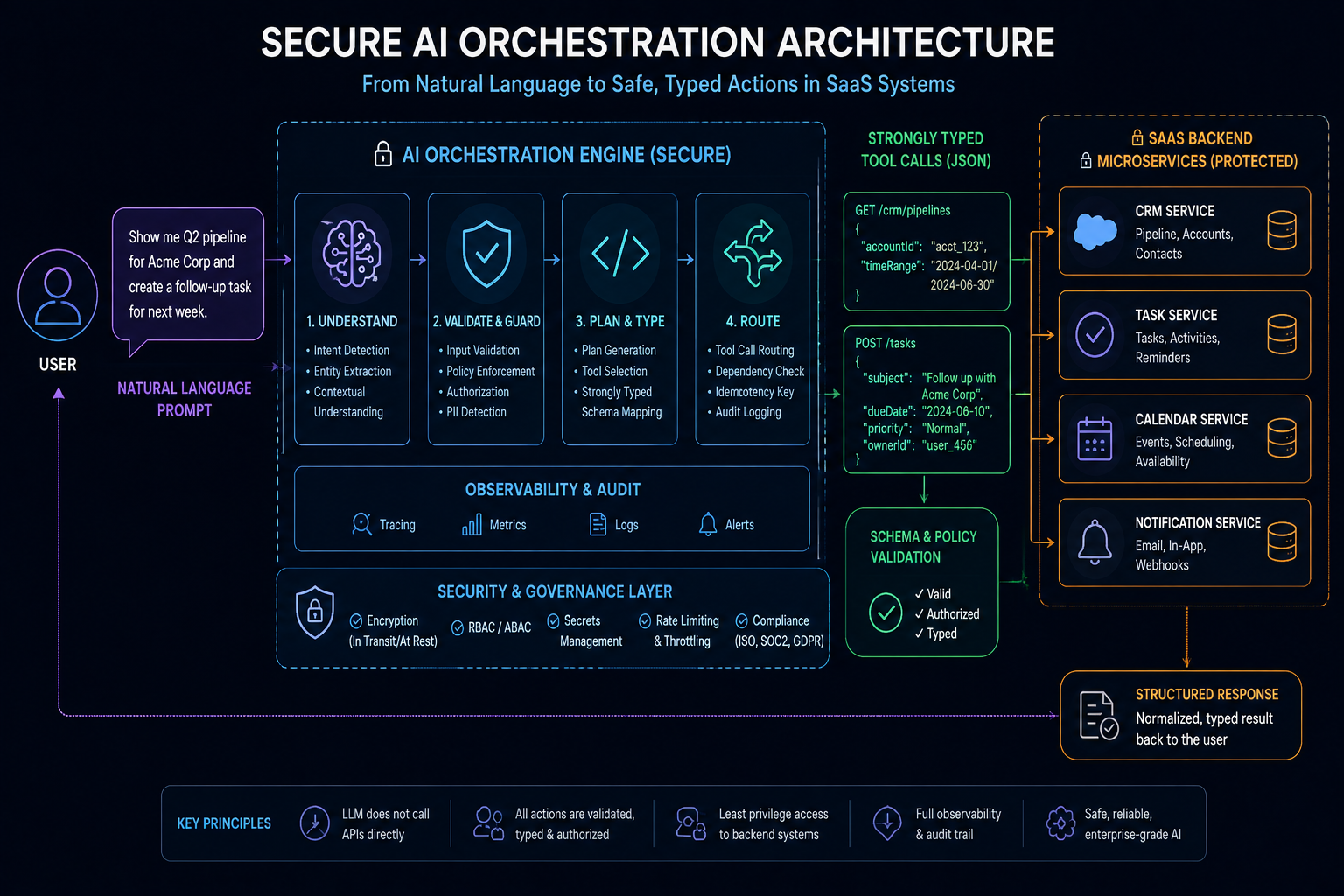
Transitioning a Software-as-a-Service (SaaS) platform from a manual, click-driven interface to an autonomous agentic system does not require rebuilding core backend microservices. By overlaying a probabilistic orchestration engine between users and existing REST APIs, engineering teams can enable natural language workflows. This approach maintains security, tenant isolation, and deterministic safety by treating Large Language Models (LLMs) as intent parsers rather than decision-makers with raw API access.
Introduction
Traditional Software-as-a-Service (SaaS) applications put the cognitive load squarely on the user. To complete a task, a user must open a dashboard, navigate UI hierarchies, fill out structured forms, and manually dispatch API requests.
Agentic interfaces reverse this dynamic. Instead of clicking through screens, users declare an outcome: “Create a high-priority task to renew the insurance policy next Thursday, and set reminders three days before and on the morning of the deadline.”
Traditional UI Model:
[User Intent] ──> [Manual UI Navigation] ──> [Form Filling] ──> [REST Endpoint]

Agentic Overlay Model:
[User Intent] ──> [Agent Orchestrator] ──> [Tool Wrappers] ──> [Existing REST APIs]
Connecting an input box directly to an LLM with raw database or API access introduces severe vulnerabilities: prompt injections, broken tenant boundaries, and non-deterministic execution. The solution is building a dedicated Agent Orchestration Layer that interacts with existing, hardened backend services through strongly typed tools and security policies.
What Happened?
Software architectures are shifting toward “intent-driven development.” Instead of building new backend endpoints or refactoring microservices to support AI agents, engineering teams are wrapping existing, stable REST APIs in tool schemas.
This architecture decouples the probabilistic layer (the LLM interpreting human natural language) from the deterministic layer (microservices enforcing business logic, database transactions, and authorization). The LLM suggests workflow steps, while downstream application code validates and executes them safely.
Why It Matters
Building an agentic layer over existing infrastructure unlocks several core benefits for software platforms:
- Zero Backend Rewrite: Existing authentication pipelines, tenant isolation checks, rate limits, and database mutations remain untouched and fully utilized.
- Granular Security Gates: High-risk actions (like bulk deletions or privilege escalation) are intercepted by policy engines before they ever hit production databases.
- Deterministic Reliability: Downstream REST APIs continue to enforce business rules, ensuring that malformed LLM outputs fail safely without corrupting application state.
- Scalable Automation: Users execute complex, multi-step workflows across distinct domain services (e.g., task management, notifications, scheduling) through a single conversational entry point.
Technical Explanation
To build a reliable agentic architecture over a legacy SaaS backend, engineers must implement three primary components: Tool Registries, Orchestration Engines, and Risk Classification Tiers.
1. Risk-Stratified Tool Classification
Tools exposed to the agent must be categorized by their potential operational impact:
| Risk Tier | Classification | Example Capabilities | Execution Strategy |
| Tier 1 | Read-Only | search_tasks, get_user_profile | Automatic execution |
| Tier 2 | Low-Impact Writes | create_task, add_reminder | System rate-limited execution |
| Tier 3 | High-Impact Mutations | bulk_reschedule, update_permissions | Requires dry-run preview |
| Tier 4 | Destructive Actions | delete_task, purge_data | Requires explicit human approval |
2. Cryptographic Binding for Human Approvals
When an agent attempts a Tier 3 or Tier 4 operation, execution halts. To prevent parameter tampering or race conditions between the proposal and the approval:
- The orchestrator computes a SHA-256 hash of the target tool name and exact JSON arguments.
- The user receives a human-readable approval prompt accompanied by the payload hash.
- Upon confirmation, the backend verifies that the submitted approval hash matches the proposed payload before executing.
+-------------------------------------------------------------------+
|               CRYPTOGRAPHIC HUMAN-IN-THE-LOOP FLOW                |
+-------------------------------------------------------------------+

 [Agent Proposes High-Risk Tool]
              |
              v
 [Orchestrator Hashes Arguments: SHA-256(Tool + Args)]
              |
              v
 [UI Displays Proposal & Approval Request to User]
              |
              v
  { User Approves Execution }
              |
              v
 [Backend Validates Hash Match] ──> [Execute Tool via REST API]
3. Idempotency Key Propagation
Network drops or agent retries can trigger duplicate actions. Tool wrappers prevent this by generating deterministic idempotency keys and passing them to existing API headers:
IdempotencyKey = Hash(RunID + StepIndex + ToolName + Payload)
Downstream services store these keys alongside database transactions, returning cached responses for identical retries without re-executing underlying database writes.
Key Highlights
- Separation of Concerns: The LLM manages intent parsing and tool selection; microservices enforce security, permissions, and database constraints.
- Context-Injected Tool Wrappers: Execution wrappers inject trusted metadata (
userId,tenantId,accessToken) directly into API calls, bypassing model prompts for critical security variables. - Prompt Injection Defense: External data (email body, user notes) is isolated inside structured XML/JSON data nodes and treated strictly as passive context.
- Distributed Tracing: Observability spans track both LLM reasoning turns and standard HTTP REST calls within unified trace logs.
Benefits
An agentic system built on existing backend APIs offers distinct technical advantages:
- Strict Tenant Isolation: Because tool wrappers use existing Bearer tokens, multi-tenant boundaries are enforced at the service level, eliminating cross-tenant data leaks.
- Graceful Degradation: If an LLM misinterprets a prompt or hallucinates arguments, strict JSON schema validation and REST endpoint validation return clear error messages to the model for self-correction.
- Predictable Cost Control: Step limits and write caps inside the orchestrator prevent infinite loops and runaway API usage.
Challenges
Implementing an agentic overlay requires addressing specific operational trade-offs:
+-------------------------------------------------------------------+
|                     IMPLEMENTATION CHALLENGES                     |
+-------------------------------------------------------------------+
|  1. Non-Deterministic Latency                                     |
|     Multi-turn reasoning loops add variable delay before a user  |
|     receives final execution confirmation.                        |
+-------------------------------------------------------------------+
|  2. Unstructured Context Resolution                               |
|     Converting relative dates ("next Thursday") to specific ISO   |
|     timestamps requires strict reference-time context injections. |
+-------------------------------------------------------------------+
|  3. Automated Evaluation Overhead                                 |
|     Validating tool accuracy requires maintaining comprehensive   |
|     assertion-based testing suites rather than simple unit tests. |
+-------------------------------------------------------------------+
Future Outlook
As enterprise software transitions away from pure GUI dashboards, “Headless SaaS” architectures will become common. Existing backend APIs will serve dual roles: powering lightweight, context-aware web interfaces and serving as the underlying execution engine for autonomous agents.
Furthermore, standardization around function calling protocols and distributed agent tracing will allow companies to safely deploy multi-agent workflows across disparate microservices with minimal human intervention.
Our Analysis
The mistake many engineering teams make when adding AI capabilities to a SaaS app is giving the model direct access to databases or generic HTTP execution tools. Treating an LLM as a trusted execution engine introduces massive security risks.
Overlaying a structured agent orchestrator on existing REST APIs offers a balanced, production-ready path forward. By insulating backend microservices behind context-injecting tool wrappers, cryptographic approval gates, and deterministic idempotency checks, organizations can deliver modern agentic experiences while maintaining enterprise-grade safety.
FAQ
Can I turn my SaaS into an agentic system without changing database schemas?
Yes. By routing agent actions through your existing REST APIs, the agent uses your current business logic, permission rules, and database schemas without requiring underlying infrastructure changes.
How do I prevent an agent from deleting tenant data?
Assign destructive actions to a high-risk tier (Tier 4) that requires explicit human approval via cryptographic argument hashing before execution can proceed.
What is the role of the Agent Orchestrator?
The orchestrator manages the execution loop between the LLM, policy engine, tool registry, and frontend client. It controls turn limits, validates JSON schemas, and evaluates risk rules.
How does the system handle relative dates like “next Friday”?
The tool execution wrapper injects the user’s explicit time zone and current reference time into the prompt or tool context, allowing the model to resolve relative dates into exact ISO-8601 timestamps.
Why shouldn’t I use generic tools like execute_sql?
Exposing raw SQL or generic HTTP request tools bypasses tenant isolation, validation logic, and authorization boundaries. Narrow, domain-specific tools keep system interactions secure and predictable.
Conclusion
Transitioning a SaaS platform into an agentic system does not require throwing away years of backend engineering. By placing a secure orchestration layer over existing APIs, companies can combine the natural-language power of LLMs with the safety and predictability of traditional microservice architectures.