
Short Summary
Autonomous AI agents can generate software faster than human engineers can review it, creating a dangerous code quality bottleneck. A “Dark Factory Pipeline” solves this by automating the happy path of software delivery—using a secondary, adversarial AI model to critique the builder model’s work—while leveraging randomized human acceptance sampling for oversight. This approach removes self-preference bias, eliminates rubber-stamping, and scales code output safely.
Introduction
As AI coding agents become increasingly capable of generating entire features, teams face a critical operational bottleneck: review capacity. When an agent creates dozens of pull requests a day, forcing human engineers to inspect every line leads to developer burnout, missed defects, and unreviewed “workslop” slipping into production.
Conversely, allowing an AI model to review and approve its own code creates an illusion of safety. Research demonstrates that large language models exhibit significant self-preference bias, consistently scoring their own reasoning and output higher than a neutral observer would.
To scale code generation safely, software engineering is borrowing a proven concept from modern manufacturing: the Dark Factory. By combining adversarial dual-model validation with statistical acceptance sampling, engineering teams can build a fully automated delivery pipeline that maintains rigorous quality control without burning out human reviewers.
What Happened?
Software teams attempting to scale AI code generation frequently run into systemic failure modes when they rely on single-model workflows or unmonitored approval gates.
In a typical flawed setup, an AI model receives a spec, generates a pull request, and is then asked to inspect its own diff before merging. Because the model relies on the exact same underlying assumptions during review that it used during implementation, critical logical flaws, edge-case oversights, and subtle security bugs go completely undetected.
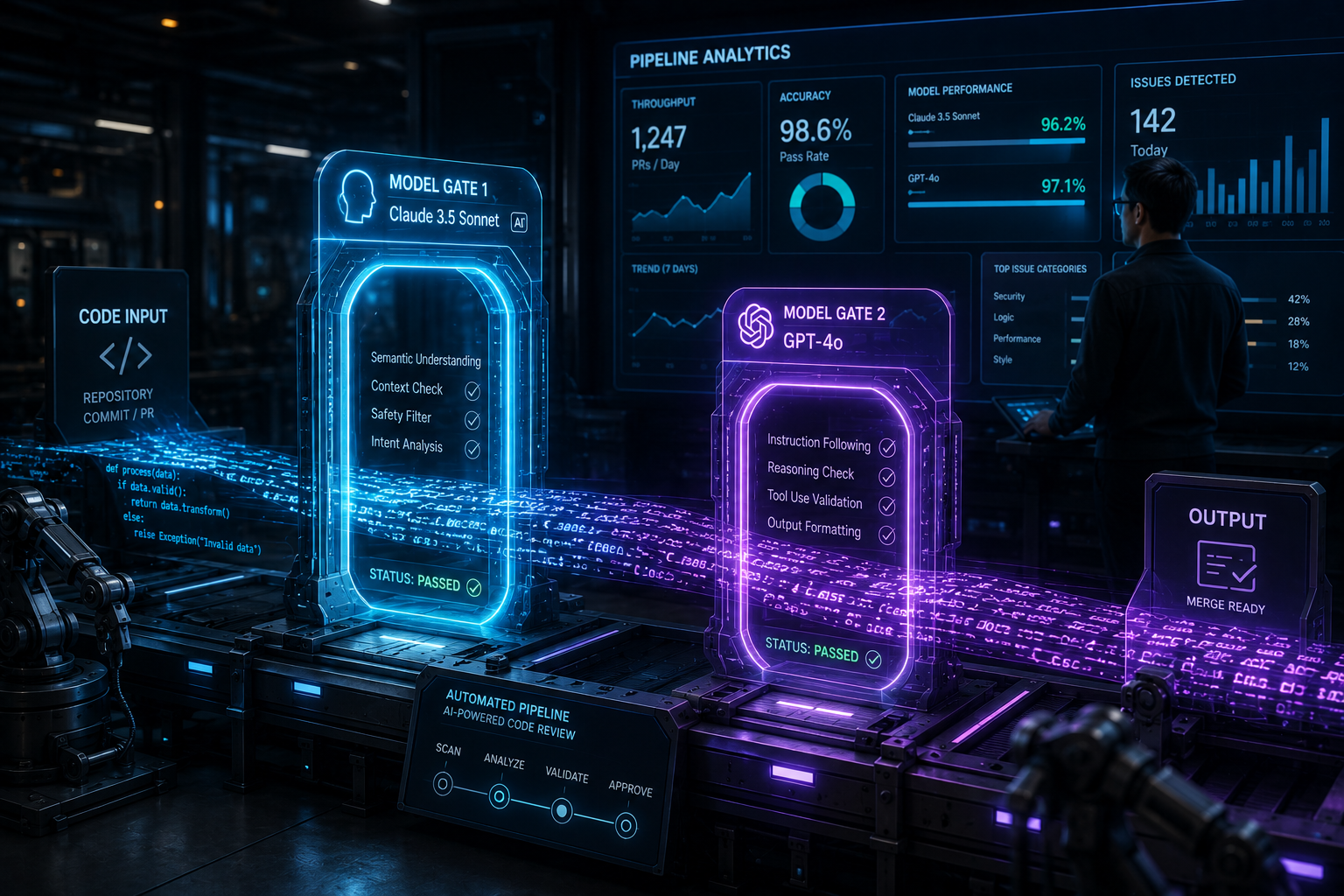
To fix this, modern AI pipeline architecture is shifting toward an adversarial “Dark Factory” model. In this setup, code generation, defect verification, and oversight are explicitly decoupled across different model providers and human sampling gates.
Why It Matters
The transition to autonomous coding pipelines changes how engineering leaders think about software quality assurance.
- Eradicating Self-Preference Bias: A model trained on a specific architecture will inherently view its own patterns as correct. Forcing a competing model family to review the diff eliminates this inherent blind spot.
- Overcoming the Human Bottleneck: Expecting engineers to review 100% of agent-generated pull requests completely defeats the productivity gains of AI automation.
- Statistical Quality Control: By shifting from absolute manual inspection to randomized lot sampling, engineering managers can maintain statistical quality guarantees while reviewing only a small fraction of merged code.
Technical Explanation
The Dark Factory architecture draws inspiration from lights-out manufacturing and industrial safety systems, like hypoxic fire suppression. In a dark factory, machinery operates around the clock in total darkness because human operators aren’t needed on the factory floor for standard operations.
In software, a Dark Factory pipeline operates by routing code through strict, non-bypassable automated gates:
+-----------------------------------------------------------------------+
|                      DARK FACTORY PIPELINE FLOW                       |
+-----------------------------------------------------------------------+

  [ Spec / Task ]
        |
        v
 +-------------------+
 |  Builder Model    |  (Model Family A - e.g., Claude)
 |  (Writes Code)    |
 +-------------------+
        |
        v
 +-------------------+
 | Adversarial Gate  |  (Model Family B - e.g., OpenAI / Gemini)
 | (Verifier Model)  |  - Purely critique-focused
 +-------------------+  - Rejects defects back to Builder
        |
        +-----------------------+
        | Passes Verification   |
        v                       v
 +-------------------+   +--------------------+
 | Merge Pipeline    |   | Human Override Log | (Triggers retry cycle
 | (Auto-Approved)   |   | (Feed to Prompt)   |  if rejected)
 +-------------------+   +--------------------+
        |
        v
 +-------------------------------------------------------------------+
 | Randomized Sampling Gate (e.g., 10% Lot Selection)               |
 | - Routes random diffs to Human Auditor                            |
 | - Human overrides logged as retraining signals                    |
 +-------------------------------------------------------------------+
The Adversarial Gate
The builder model (Model A) reads a task specification and submits a pull request. However, Model A is strictly barred from approving its own work.
The diff is immediately routed to an Adversarial Verifier (Model B). Crucially, Model B must belong to an entirely different vendor or model architecture than Model A. Model B’s system prompt is configured exclusively to find defects, security vulnerabilities, and spec deviations. Model B cannot fix the code; it can only approve or issue a structured rejection. If rejected, the feedback returns to Model A for remediation.
Acceptance Sampling
Once the adversarial gate passes, the code merges automatically. To prevent systemic drift, the pipeline applies manufacturing acceptance sampling. A predefined percentage of merged pull requests (e.g., 10%) is selected at random and assigned to a human engineer for a post-merge audit.
Key Highlights
- Multi-Vendor Architecture: Combines distinct model families (such as Anthropic, OpenAI, or Google) to prevent vendor-specific blind spots.
- Strict Separation of Concerns: The model that authors the code is structurally forbidden from reviewing or approving the pull request.
- Zero-Bypass Automated Gates: Merges are blocked unless they pass the adversarial verifier and complete the sampling telemetry log.
- Continuous Correction Signals: Any instance where a human auditor overrides an AI verifier’s decision is logged, flagged, and fed back into the pipeline as a prompt optimization signal.
Benefits
Applying a dark factory pattern to AI coding pipelines yields significant operational advantages:
- Massive Load Reduction: Human engineers review only a randomized sample (e.g., 10%) of generated pull requests, cutting review workloads by up to 90% while retaining defect detection capabilities.
- Eliminated Rubber-Stamping: Automated adversarial checking ensures that simple oversights are caught immediately, saving human attention for high-level domain logic.
- Scalable Throughput: The pipeline continues merging verified code continuously, allowing agents to work asynchronously across time zones.
- Auditable Feedback Loop: Override telemetry creates a growing dataset of edge cases that can be used to fine-tune system prompts and improve future model behavior.
Challenges
Implementing an autonomous dark factory workflow comes with trade-offs that teams must manage carefully:
+-------------------------------------------------------------------+
|                        IMPLEMENTATION PITFALLS                    |
+-------------------------------------------------------------------+
|  1. Increased Latency & API Costs                                 |
|     Running multiple high-tier models per pull request increases  |
|     per-diff inference expenses and execution time.               |
+-------------------------------------------------------------------+
|  2. Under-Sampling Risk                                           |
|     Setting the human sampling rate too low allows subtle logic   |
|     bugs to compound into major incidents before detection.       |
+-------------------------------------------------------------------+
|  3. Shared Domain Blind Spots                                     |
|     If both models lack domain context, they may jointly miss     |
|     critical business logic failures that only humans recognize.  |
+-------------------------------------------------------------------+
Future Outlook
As multi-agent orchestration frameworks mature, the dark factory model will become the standard architecture for high-velocity software engineering teams.
Future pipelines will likely feature specialized model ensembles—combining dedicated static analysis models, security-focused verifiers, and formal verification tools within the adversarial gate. As these automated gates become more sophisticated, human oversight will shift almost entirely from line-by-line diff inspection to high-level spec engineering and system-level architectural auditing.
Our Analysis
The Dark Factory pattern addresses the fundamental fallacy of AI development: the belief that higher code velocity automatically translates to higher engineering output. Without robust, independent verification, high-velocity AI code generators simply create high-velocity technical debt.
By borrowing time-tested quality control principles from industrial manufacturing—specifically separation of duties and acceptance sampling—software teams can safely step off the manual review treadmill. The key lies in recognizing that AI verifiers are not meant to replace human judgment entirely, but rather to act as a rigorous, non-biased filter that keeps human engineers focused where their domain expertise matters most.
FAQ
What is a “Dark Factory” in AI coding?
A dark factory pipeline is an automated software delivery setup where AI models write and verify code autonomously on the happy path, requiring no direct human intervention for standard merges, backed by randomized human audits.
Why can’t the same AI model review its own code?
AI models suffer from documented self-preference bias. A model asked to evaluate its own output is highly likely to repeat the same flawed assumptions that caused the bug in the first place.
What is acceptance sampling in software development?
Borrowed from industrial manufacturing quality control, acceptance sampling involves reviewing a small, randomly selected percentage of completed work (e.g., 10% of pull requests) to statistically verify the quality of the entire batch.
Why must the builder and verifier models come from different vendors?
Models within the same family often share similar training data, architecture flaws, and evaluation biases. Using models from different vendors (e.g., pairing Claude with GPT-4o) ensures a genuinely independent review.
What happens when a human reviewer overrides an AI decision?
When a human overrides the adversarial verifier (either approving a rejected PR or flagging a passed one), the discrepancy is logged as a feedback signal to refine system prompts and verifier instructions.
Conclusion
Scaling AI code generation requires moving away from the dangerous extremes of 100% manual review or unmonitored self-approval. By deploying an adversarial model from a separate vendor to police the builder, and backing that gate with randomized human acceptance sampling, teams can build a resilient Dark Factory pipeline. This approach achieves the holy grail of modern software delivery: dramatically higher code throughput paired with uncompromising quality control.